Family Guy The Quest for Stuff
- 3.6
- Rating
- 10.00M
- Installs
- Free
- Price

 Analysis by App-foxy
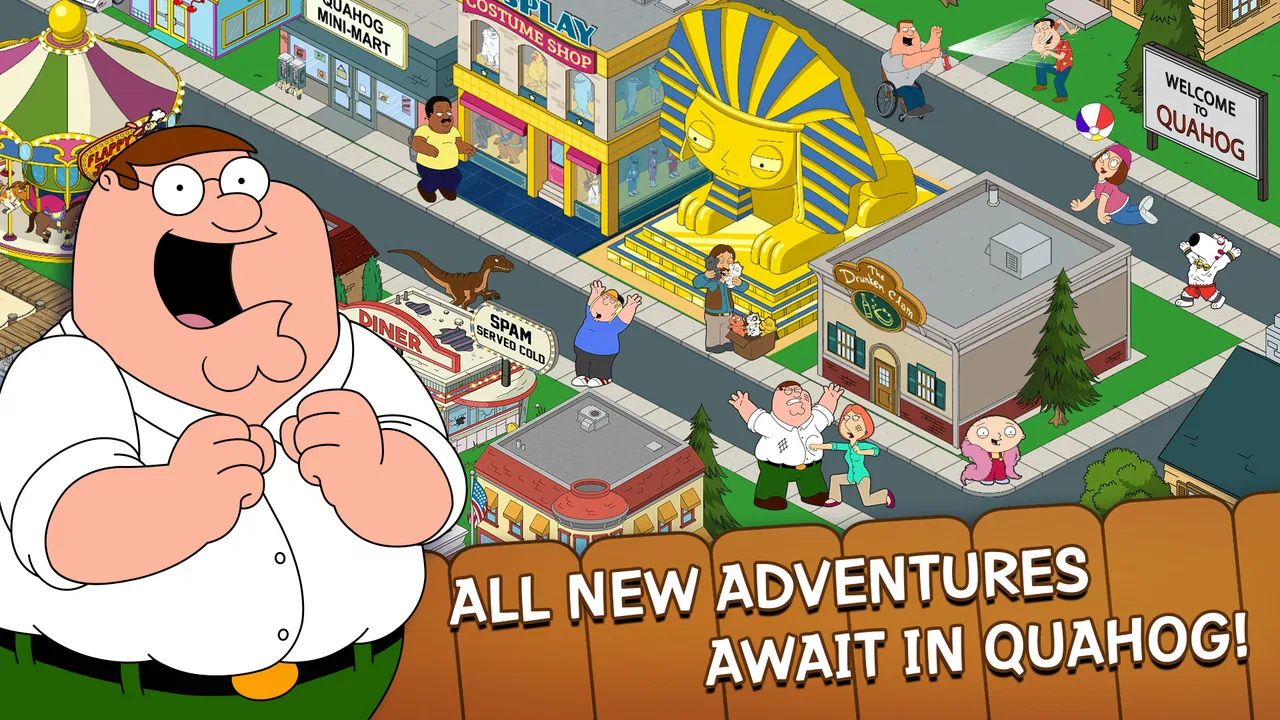
What kept me playing Family Guy The Quest for Stuff was not the promise of a traditional adventure game, but the way it turns Quahog into a small, constantly changing sandbox. I build up the town, collect familiar characters, send them through tasks, and gradually reshape the space around them. That central loop feels closer to a light city-building game with comedy-driven quests than to an action adventure, and that distinction matters before you download it.
In my experience, the game works best when I treat it as a relaxed check-in rather than a title demanding uninterrupted attention. I can open it, decide which characters should work on which objectives, make a few town changes, and leave until the next useful moment. The appeal comes from seeing the settlement develop while the cast creates the jokes and interruptions that give each activity its Family Guy identity.
It is a free game from Jam City, Inc., aimed at mature players and listed for Android devices running version 8.0 or later. The store classifies it as an adventure title, although its day-to-day play is much more about planning, collecting, construction, and waiting than exploring a dangerous world directly. That makes it approachable, but it also means anyone expecting fast combat or a deep story campaign may come away disappointed.
You May Also Like

 Blood Strike: 2.5 Anniversary
Blood Strike’s Loadouts Turn Every Drop Into a Tactical Gamble
A close look at Blood Strike’s custom loadouts: how fast access to signature weapons reshapes its battle royale rhythm, rewards preparation, and narrows the gap between fights.

 Pandora - Music & Podcasts
Pandora’s Music Is Easy to Start, but Harder to Recover
Pandora’s strength is its low-effort path from a seed to a station. Its weak spot is how much confidence it asks you to place in connection, setup, and quiet recovery.

 8 Ball Pool
 Is Built on Rivalries, Rematches, and Routine
A close look at the rivalries, rematches, shared routines, and unanswered safety questions that turn a quick pool match into a persistent mobile community.

 Samsung Music
’s Quiet Strength Is Playing What You Already Own
Its reach comes less from spectacle than from dependable access to a personal library. That simplicity is both the app’s strongest retention engine and its ceiling.

 AccuWeather: Weather Radar
AccuWeather Review: A Quick, Clear Forecast for Everyday Decisions
For everyday plans, the best forecast is the one you can understand quickly. AccuWeather makes rain timing, radar, and local conditions easy to act on, with a few trade-offs.

 Hill Climb Racing
Why Hill Climb Racing Still Turns Crashes Into One More Run
A tiny car, a bumpy hill and one more upgrade: Hill Climb Racing keeps resurfacing because its simple chaos makes every near-miss feel personal.
More From Our News Desk
View All News


Building Quahog is the real adventure
I focus on what makes Quahog’s growth feel like an adventure of its own: each early objective gives me a practical reason to look around, while the town’s gradual changes help me see what those actions accomplished. I also find it useful to treat the first goals as a chance to learn the game’s rhythm, rather than rushing to fill every space. From there, the clearest measure of progress is what becomes available and how the town changes.
Why the town-building capability matters
The most important capability here is the combination of city building and character collection. Instead of moving through a fixed sequence of levels, I work toward a more personal version of Quahog. Buildings, characters, and objectives gradually give the map a sense of progress, so the town becomes the record of what I have already achieved.
That structure changes the way I judge success. In an ordinary adventure game, I usually ask whether I have defeated an enemy or reached the next chapter. Here, I ask whether I have unlocked another useful character, completed a construction step, or arranged my available tasks efficiently. The reward is cumulative: a small decision now can make the next visit feel more productive.
The character collection is not just a decorative checklist. Each new member of the cast gives the town more personality and creates another reason to inspect the available objectives. I enjoy the contrast between the familiar animated characters and the deliberately mundane work of managing a growing settlement. Sending someone to perform a task feels funnier when the game frames it through the show’s exaggerated tone.
The sandbox element also gives the game a calmer rhythm than many adventure releases. I am not forced to react quickly every second. I can look over the town, decide what deserves attention, and make progress in short sessions. For players who enjoy organizing spaces and watching a collection grow, this is the feature that carries the whole experience.
What the first sessions feel like
Early play introduces the basic relationship between quests, construction, and character activity. I learn that progress is rarely about one isolated action. A task may support a building objective, a building may open another part of the town, and a newly available character may help with a later goal. The game encourages me to think in chains rather than treating every action as separate.
I recommend resisting the urge to place every available item immediately. A crowded town can become harder to read, especially when several characters and buildings compete for attention. I found it more comfortable to keep enough visual space around important locations so I could identify what needed interaction without tapping randomly through a busy screen.
Another useful habit is checking the whole task situation before committing characters. It is tempting to start the first available activity, but a quick look at the broader objective can prevent an awkward delay later. When several characters are available, I prefer assigning the longer or more restrictive task first and using the remaining cast for shorter actions. This simple order makes the town feel less idle during my next visit.
The strongest part of the design is that progress remains visible. Even when a session is short, I can usually point to something that changed: a new part of the town, another collectible character, or a clearer route toward the next goal. That visible movement is more satisfying than a system where rewards disappear into menus and never affect the world on screen.
How the loop works in everyday use
A typical visit begins with scanning the town for available actions. I collect what has finished, review which characters are free, and then choose the next set of tasks. After that, I spend time on construction or layout decisions before leaving the game. The process is simple, but it rewards a little preparation because the wrong assignment can leave a useful character unavailable when I need one.
This is particularly convenient during small gaps in the day. If I have a few minutes before leaving home, I can launch the game, start several activities, and close it without feeling that I abandoned a complicated mission. Later, I return to a town that has moved forward. That makes it a better fit for intermittent play than for someone seeking a long, uninterrupted adventure session.
The comedy is important because the underlying management loop could otherwise become repetitive. Family Guy’s humor gives the tasks a recognizable voice and makes the cast feel like more than interchangeable workers. I would not call every joke equally effective, but the tone helps distinguish this game from a generic town builder with anonymous residents.
At the same time, the humor does not replace the need for patience. The game still asks me to repeat the basic pattern of assigning, waiting, collecting, and building. If that cycle is not enjoyable on its own, the show’s characters will not completely solve the problem. The licensed setting adds flavor; it does not turn a management game into an action title.
A realistic scenario for casual players
Imagine using it during a busy weekday. In the morning, I open the game and assign available characters to tasks that can run while I am working or commuting. At lunch, I collect completed actions and start a second group. In the evening, I spend more time arranging the town and following the next objective. I have made progress without needing to reserve an entire hour for play.
This routine also reveals a trade-off. The game is convenient because it supports short visits, but those visits can feel similar if I do not have a new construction goal or character milestone to pursue. I get the most from it when I treat the town as a long-term project rather than expecting every login to deliver a dramatic event.
Where it differs from other adventure choices
Compared with a conventional mobile adventure game, this one gives me less direct control over moment-to-moment action. There is no emphasis on manually guiding a hero through a fast sequence of battles or platforming challenges. Instead, my decisions are about timing, priorities, collection, and the shape of the town.
Compared with a pure city-building game, it has a stronger character and comedy focus. I am not only balancing a settlement in an abstract way; I am building around a recognizable cast and using the show’s personality to make routine objectives more entertaining. Someone who wants detailed economic simulation may find the system too light, while a Family Guy fan who wants a relaxed collection game may find the balance more appealing.
It also differs from story-heavy adventure games because the narrative is experienced through the ongoing activity of the town rather than through a single tightly paced campaign. I can play at my own rhythm, but that freedom means the story may feel less urgent. Players who prefer carefully staged chapters and constant plot momentum should probably look elsewhere.
The cost of a free starting point
The game is free to download, which makes it easy to try the central loop without committing money at the beginning. However, optional purchases range from $0.99 to $99.99 per item. That wide range is worth keeping in mind because a free entry point does not mean every route through the town will feel equally comfortable without spending.
My advice is to decide early what kind of player you are. If you are happy to progress gradually, use the game as a check-in experience and accept that some goals take patience. If you dislike waiting or feel pressure whenever a purchase appears, the free model may become frustrating rather than relaxing. The right question is not simply whether the download costs anything; it is whether the pace feels acceptable when you choose not to buy.
There is also a psychological trade-off in collection games. Seeing another character or town improvement within reach can make the next objective feel especially attractive. That motivation is harmless when it encourages regular play, but it can become tiring if every session turns into a comparison between patient progress and faster paid progress. I prefer setting my own stopping point instead of treating every available item as something I must obtain immediately.
Content, device fit, and expectations
The mature 17+ rating is an important part of the decision. The game uses the adult-oriented tone associated with Family Guy, so I would not install it on a child’s device simply because the colorful presentation looks like a family cartoon. Parents should consider the rating and the show’s style together rather than judging the game by its bright visuals.
On the technical side, the listed minimum requirement is Android 8.0, and the current version is 8.2.0. That gives prospective players a straightforward compatibility check before downloading. I still recommend leaving enough storage and using a stable connection for a smoother experience, especially when the town contains many items and characters, though the most important practical question is whether your device meets the stated operating-system requirement.
The game has reached over 10 million installs, with an average score of 3.6 from around 990 thousand ratings and roughly 114 thousand written reviews. Those figures suggest a large audience but also a mixed reception. I read that combination as a warning to keep expectations specific: the game clearly attracts many players, yet its waiting, collection, and purchase-driven structure will not suit everyone.
Small strategies that improve the experience
My first practical tip is to group decisions by purpose. Before tapping through individual tasks, I identify the next construction or collection target and then assign characters around it. This reduces the feeling of busywork because every action has a place in a larger plan. It also helps me notice when I am spending time on an attractive side activity that does not support what I actually want to unlock next.
Second, I avoid treating the town as a finished design too early. Leaving room for later changes makes it easier to reorganize when new buildings or characters arrive. A neat layout at the beginning may look satisfying, but rebuilding repeatedly can become more annoying than leaving a flexible arrangement until I understand how much space the growing settlement needs.
Third, I use short sessions to prepare longer gaps rather than trying to squeeze every reward out of every visit. Starting suitable tasks before work, sleep, or travel gives the waiting structure a purpose. When I return, I have a clear collection point and can make the next decision quickly. This approach makes the game feel like a background hobby instead of an obligation.
Finally, I pay attention to whether I am enjoying the comedy and town design, not just chasing the next unlock. If I stop noticing the characters and only see timers or requirements, that is usually a sign to take a break. The game’s best quality is its playful setting, so playing mechanically can strip away the reason to keep it installed.
Who will get the most from it
I think this is a good match for Family Guy fans who enjoy seeing the cast placed in an interactive setting, especially those who already like casual city builders. It also suits players who want a game that can be checked several times a day without demanding constant concentration. The collection aspect gives long-term direction, while the sandbox town provides a visible sense of ownership.
It is less suitable for someone looking for a competitive multiplayer experience, precise controls, or a serious adventure narrative. I would also hesitate to recommend it to players who strongly dislike timers, repeated task assignment, or in-app purchase prompts. A different adventure game will be better if your ideal session involves immediate action and a clear beginning-to-end mission.
For younger players, the mature rating is a firm reason to skip it. The cartoon appearance does not change the intended audience. For adults who know the source material and are comfortable with a free-to-play collection loop, the rating is less surprising, but it is still useful context before installation.
My final take after living with the town
Family Guy The Quest for Stuff succeeds when I approach it as a humorous, slow-growing town project rather than a conventional adventure. Its best feature is the way character collecting gives the city-building loop a recognizable personality. I always have a reason to look around Quahog, and even small changes feel more meaningful because they involve a cast I already understand.
The limitations are equally clear. The repeated assignment-and-wait rhythm can become routine, the free-to-play structure requires self-control, and the mature comedy will not suit every household. The game’s moderate average rating reflects that divided appeal: there is a substantial audience, but the design asks for a particular kind of patience.
I would recommend trying it if you want a casual sandbox that works well in short visits and you enjoy Family Guy’s humor. Start slowly, keep the town flexible, plan character tasks around your daily schedule, and do not assume that every available purchase is necessary. If you want fast action or a tightly paced adventure, choose another game. If you want to watch a familiar animated town grow according to your decisions, this one has enough personality to make the routine worthwhile.
FAQs for Family Guy The Quest for Stuff
01What is Family Guy: The Quest for Stuff?
Family Guy: The Quest for Stuff is a free-to-play city-building and adventure game based on the animated television series. After Quahog is destroyed in a chaotic event, players help Peter Griffin rebuild the town by completing missions, collecting resources, and unlocking familiar characters, buildings, decorations, and story scenes inspired by the show.
02Is Family Guy: The Quest for Stuff free to download and play?
Yes, the game can generally be downloaded and played for free on supported Android and iOS devices. However, it includes optional in-app purchases for premium currency, character items, bundles, and faster progress. You can enjoy the main gameplay without paying, although rebuilding Quahog may take longer if you choose not to spend money.
03Does the game require an internet connection?
An internet connection is normally required for Family Guy: The Quest for Stuff because the game connects to its servers, synchronizes progress, delivers events, and validates purchases. Some previously loaded content may appear accessible briefly while offline, but the full experience is not designed for permanent offline play. A stable connection is recommended.
04Are the original Family Guy characters and humor included?
The game features many recognizable characters from Family Guy, including Peter, Lois, Stewie, Brian, Chris, Meg, Quagmire, and other residents of Quahog. It also uses dialogue, jokes, references, and situations based on the show’s distinctive adult-oriented humor. Because of this, the game may not be suitable for younger children.
05Can I play Family Guy: The Quest for Stuff on any Android or iPhone?
The game is not guaranteed to work on every device. Compatibility depends on the operating system version, available storage, memory, graphics performance, and the requirements listed in the relevant Google Play Store or App Store page. It may require a relatively large download and additional space for updates, so checking device compatibility before installing is advisable.
Pros
- Familiar characters and locations feel authentic to Family Guy fans.
- Frequent events add new goals and keep the town-building loop active.
- Simple controls make it easy to play casually on phones and tablets.
- Humorous dialogue and cutscenes capture the show’s irreverent style.
- Many buildings and decorations allow for highly personalized town designs.
Cons
- Progress can become slow when premium currency is needed for key items.
- Large updates may require considerable storage space on your device.
- Timed events can feel stressful if you cannot play regularly.
- Some tasks rely heavily on waiting
- with limited offline progress.
- The humor and references may not appeal to players unfamiliar with the show.

Family Guy The Quest for Stuff
Gallery